
Golden Star KYC Verification: Documents and Withdrawal Checks
 Available in AU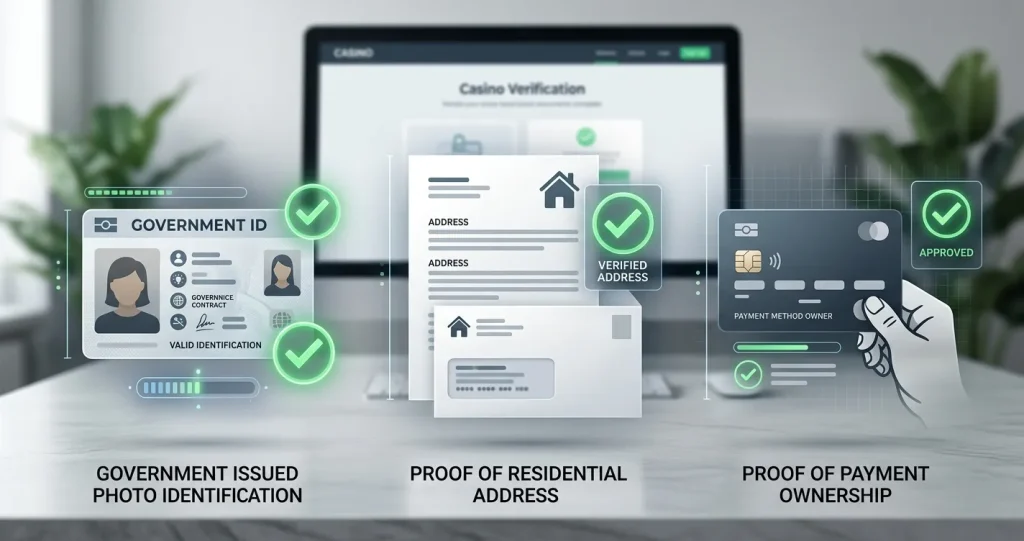
Golden Star’s current KYC framework centres on identity, address and payment ownership, with additional evidence possible when required.
Golden Star’s current terms describe KYC as an obligatory player-verification procedure. The core document categories supported by the current official evidence are government-issued photo ID, proof of address and proof of payment. The terms say proof of address should be no older than 90 days and explain that payment evidence should identify the payment account holder, transaction amount and payment date, although the exact evidence can differ by payment method. Verification matters directly to withdrawals because the terms state that missing requested KYC documents can prevent payment. There is no fixed KYC completion time that this guide can responsibly promise. The practical goal is therefore payout readiness: keep account details consistent, prepare clear current documents when requested, and understand that a withdrawal can remain unresolved while verification is incomplete.
What Golden Star KYC is checking
The current terms describe KYC as a process intended to establish three broad points: that the account holder is a real person, that deposited funds are legitimate and belong to that person, and that released funds reach the correct person and payment destination. That makes verification more than an age check.
Golden Star can also request further information when the standard set is not enough. The current KYC policy refers to additional checks for higher-risk circumstances, unusual transactions and source-of-funds questions. Those possibilities should not be turned into a claim that every player will face the same extended review. The reliable baseline is the three core document categories below.
1. Proof of identity
The current terms call for government-issued identification containing the holder’s full name, date of birth, issue or expiry information and a photograph. Examples listed by the operator include a passport, identity card and driver’s licence.
From a practical document-quality perspective, the useful goal is to make the requested information readable in a single submission. A photograph or scan should not cut off document edges, obscure the name or date of birth, or hide information that the verification request specifically asks to see. Do not alter document details or submit another person’s identification.
The identity document should also match the personal information used when the account was created. If the account carries a nickname while the ID carries a different legal name, or the date of birth was entered incorrectly, verification can require additional support contact before the records line up.
2. Proof of address
Golden Star’s current terms say proof of address should confirm the place of residence stated during registration and show the account holder’s full name and residential address. They state that the document should be no older than 90 days. Examples include a utility bill, bank statement or insurance document.
The KYC policy also lists utility bills and bank statements as address evidence. The important point is not the logo on the document but whether the current residence, account holder and issue date can be checked against the account record.
If an address has changed since registration, update the account through the proper support or account-management route before assuming an older document will be accepted. The terms specifically reserve the ability to request new proof when residence information changes.
3. Proof of payment or payment ownership
The current terms define proof of payment as evidence that the account holder sent the payment to the casino. In principle, the document should show the amount debited, the name of the payment-account holder and the payment date. The exact verification route can differ because cards, bank transfers, e-wallets and cryptocurrencies do not all create the same type of record.
This category is why using third-party payment accounts creates unnecessary verification risk. Golden Star’s terms prohibit third-party payment systems for account funding and withdrawal. A payment method in the same name as the casino account is easier to reconcile with the identity check than a method owned by somebody else.
Do not send full card security codes, passwords or unrelated financial records just because a verification screen exists. Follow the exact fields requested through the official account or support channel and redact only where the official instructions permit it.
How KYC connects to withdrawals
Golden Star’s current terms state that non-provision of requested KYC documentation prevents the player from receiving payments. They also say an account can be suspended or closed if the requested procedure is not completed after contact attempts.
That creates a clear sequencing issue: pressing the withdrawal button is not necessarily the final step before payment. A request can trigger or remain subject to verification before the casino releases funds. This is why the Golden Star withdrawals separates request, KYC, approval, casino processing and external settlement.
The current stated minimum withdrawal for an AUD account is A$45. That figure is a cash-out threshold, not a KYC threshold. Verification can be requested independently of the size of one withdrawal, so it would be inaccurate to treat A$45 as a level below which checks do not apply.
No fixed KYC completion time is promised here
The current terms explain what documents can be required and how an incomplete procedure affects payments, but this page does not publish a guaranteed number of hours or working days for KYC completion. Review time can depend on document quality, whether more information is requested, payment ownership checks and the complexity of the account review.
That distinction matters because a withdrawal-processing target and a KYC-review time are not the same metric. Golden Star can have a stated target for processing an approved withdrawal while the account is still waiting for verification before approval. Treating the two clocks as one would create a misleading payout promise.
Document-preparation checklist
A useful KYC checklist should reduce preventable friction without inventing operator rules. The following steps are consistent with the current terms and ordinary document handling:
- Use the same legal name and date of birth as the casino account.
- Make sure the photo ID is current and readable.
- Use an address document showing the registered residence and required identifying details.
- Check that proof of address is within the stated 90-day age window.
- Use payment evidence that connects the payment method to the account holder.
- Make sure requested transaction information is visible where the payment proof requires it.
- Submit documents only through Golden Star’s official account or support route.
- Keep copies of what was submitted so you can answer a follow-up request consistently.
What can trigger extra verification
The current KYC policy says the company can perform additional checks and may suspend accounts until satisfactory information is received. It also describes enhanced due diligence for higher-risk customers, large or unusual transactions and source-of-funds or source-of-wealth reviews.
Those sections support one important conclusion: the three-document baseline is not an absolute ceiling on what can be requested. At the same time, a review should not present every enhanced check as routine for every account. Extra checks are situational, and the actual request should be followed as it appears in the account or official support communication.
Registration details need to survive verification
KYC starts with information that was entered earlier. Golden Star’s registration procedure asks for date of birth, name, address, email, username or password credentials and telephone information. Verification later asks for evidence that can validate parts of that profile.
If you are still at the account-creation stage, read the Golden Star registration first. For Australian readers this is especially important because current official pages contain conflicting country-access signals, and the registration guide explains why an English-Australia locale should not be treated as a guarantee that sign-up is accepted.
KYC and legal status are different issues
Identity verification answers whether the casino is satisfied with the account holder, residence and payment ownership. It does not itself answer whether the operator holds an Australian licence or how Australian gambling law treats the service. Those are separate questions.
The project keeps that distinction explicit. The Golden Star licence and legal status handles regulator and licence facts, while this page stays focused on document verification and payout readiness.
Common KYC mistakes to avoid
Submitting an unreadable ID imageIf the name, date of birth, photograph or issue details cannot be read, the document cannot perform the verification job it was requested for.Using an old address documentThe current terms specify a 90-day window for proof of address, so an older bill or statement can create a preventable mismatch.Funding from another person’s accountPayment ownership is one of the explicit KYC categories and third-party payment use is prohibited by the terms.Assuming one completed KYC check lasts foreverThe terms allow Golden Star to request updated or additional evidence, including when an identity document expires or residence information changes.Confusing verification with withdrawal processing timeVerification can occur before a withdrawal reaches the approved-processing stage, so the clocks should be treated separately.
Bottom line
Golden Star’s current KYC rules are specific enough to prepare for without inventing a fixed review time. The core evidence is government-issued photo ID, proof of address and proof of payment, with the operator able to request more information where necessary. The current address document rule uses a 90-day freshness window, and incomplete verification can block payments.
For an AUD account, the current minimum withdrawal is A$45, but that amount does not remove the need for KYC. The best approach is to keep registration details accurate, use payment methods in the account holder’s name, submit readable current documents when asked and treat KYC as a separate step from the casino’s later withdrawal-processing stage. For the broader review, return to the Golden Star Australia review.